HRT's News
Company News




Recently, HRT in collaboration with the Daxiang Research Institute, officially released the "China Used Serviceable Material(USM) Market Insights, 2025 Review and 2030 Outlook", actively seizing the Hundred-Billion-Yuan USM Opportunity. This report aims to provide an in-depth analysis of the underlying logic behind this transformation, comprehensively exploring the supply-demand landscape, compliance pathways, and ecosystem development of China's USM market through detailed data and multi-dimensional perspectives.
In the post-pandemic era, the global aviation manufacturing industry faces severe challenges from supply chain disruptions and sluggish production capacity ramp-up. New aircraft delivery delays, shortages and extended lead times for OEM parts becoming increasingly common. This dramatic external volatility, combined with rising maintenance costs driven by fleet aging, has compelled Chinese airlines and MRO enterprises to seek more resilient and cost-effective solutions.
Against this backdrop, used serviceable material (USM) is no longer merely a supplementary means of cost reduction, but a strategic resource for ensuring fleet airworthiness and hedging against supply chain risks. China's USM market is entering a critical demand window.
Ⅰ. Industry Overview
Ⅱ. Market size
(I)Global USM Market Size
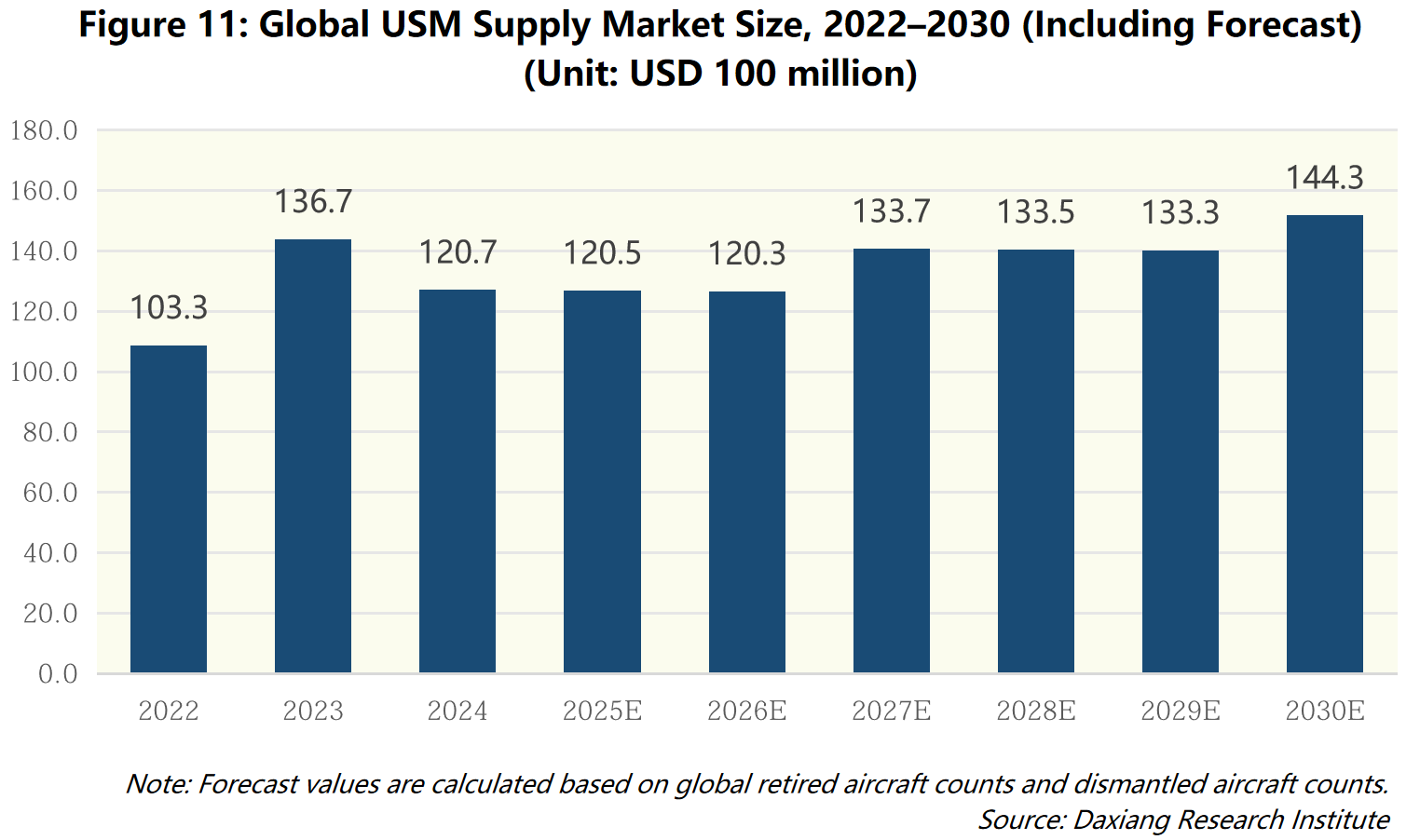
From the supply side, the global USM comes from an average of 800–1,200 retired aircraft per year. The data indicates that approximately 14,700 narrow-body aircraft and approximately 2,950 wide-body aircraft delivered between 2010 and 2025 will enter the dismantling peak period in the next decade, constituting a stable "raw material" foundation for the market and serving as the main source of USM market supply for the next ten years.
Based on a global retired aircraft-to-dismantling ratio of 80%, the global USM supply market size in 2022 was approximately $10.33 billion, growing at a compound annual growth rate of approximately 4.3% to $14.43 billion by 2030.
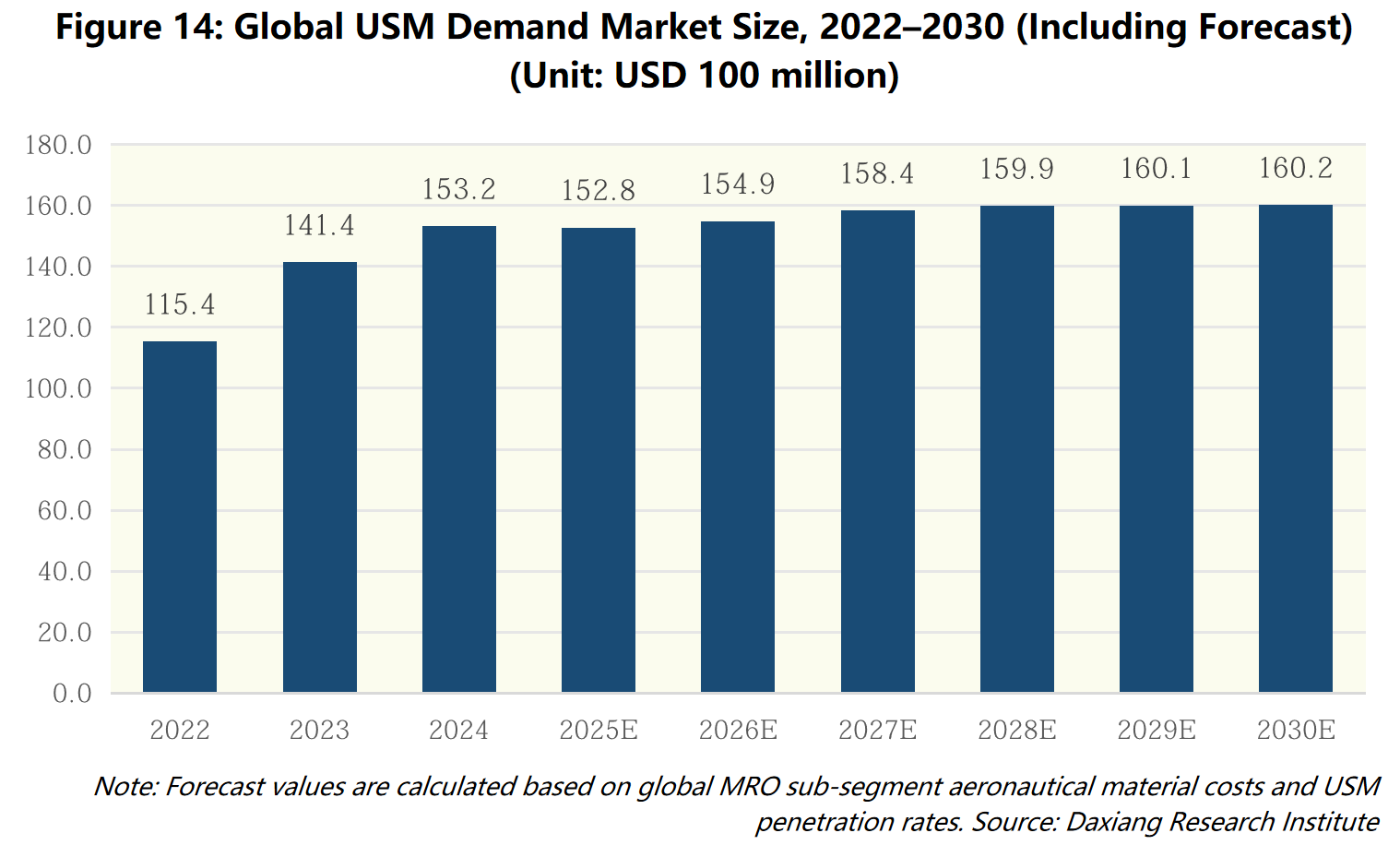
Combining this with the penetration rate of USM in MRO aeronautical material applications (growing from 19% in earlier years to 24%), it can be concluded that the global USM demand market size will grow from $11.54 billion in 2022 to $16.02 billion in 2030, with a compound annual growth rate of approximately 4%, showing stable growth in market demand.
(II)China's USM market size
China's USM market is at the intersection of profound supply-side adjustments and explosive demand-side growth. On the one hand, domestic aircraft dismantling capacity on the supply side has begun to take shape, but the industrial chain ecosystem and deep recycling technology still have shortcomings. On the other hand, demand-side needs are extremely urgent: airlines face enormous cost and supply chain pressures, and the country also urgently needs to develop the USM industry to practice the green circular economy.
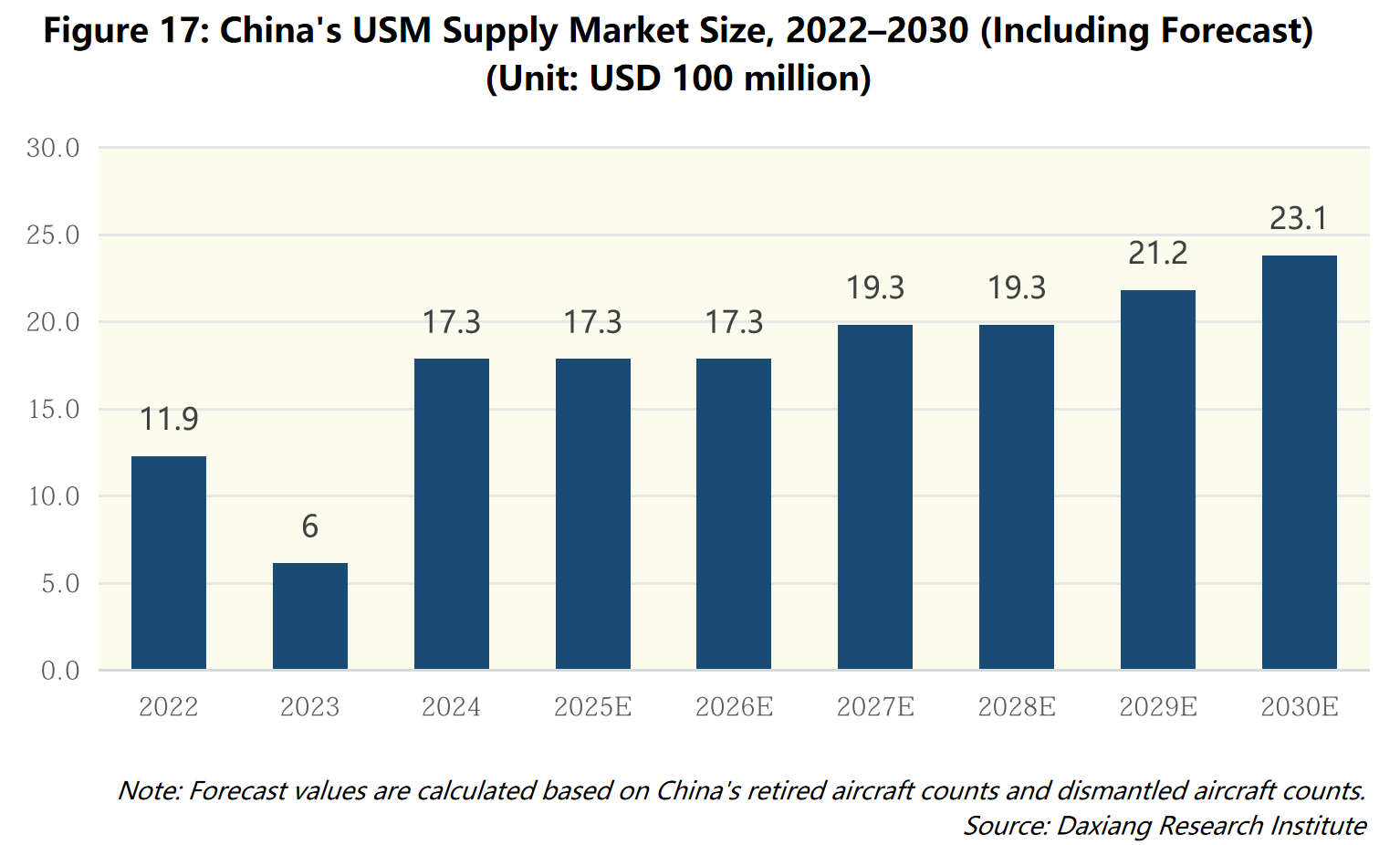
Based on an estimated 80% of retired Chinese aircraft being sent for dismantling, China's USM supply market size in 2022 was $1.19 billion, and is projected to grow at a compound annual growth rate of approximately 8.6% to reach $2.31 billion by 2030.
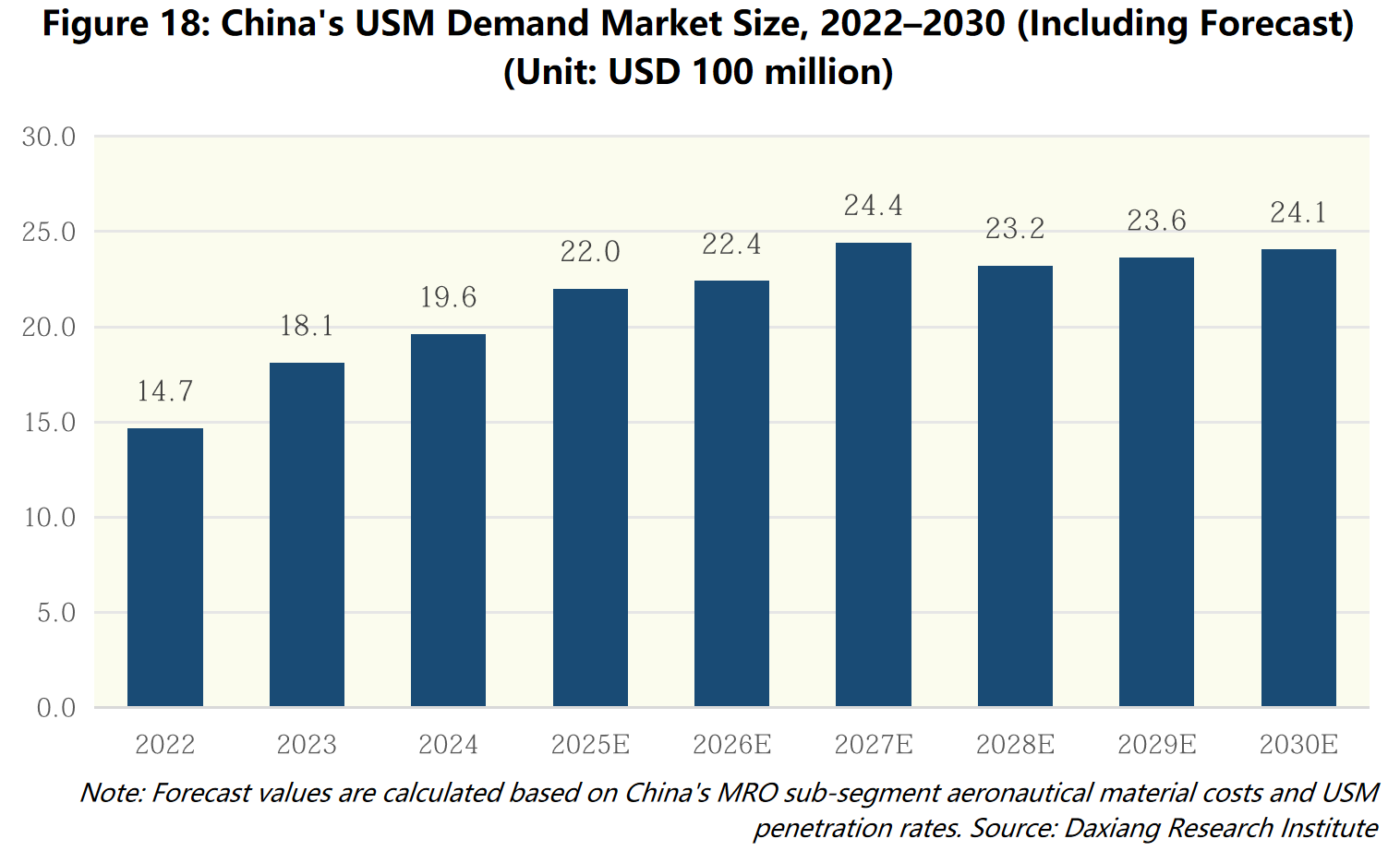
In terms of USM market demand, the size of China's USM demand market will grow from USD 1.47 billion in 2022 to USD 2.41 billion by 2030, with an average annual compound growth rate of approximately 6.4%. The market demand is showing a steady growth trend.
Ⅲ. Market Challenges
Standing at the historic juncture of 2026, the opening year of the 15th Five-Year Plan, China’s USM sector finds itself at a genuine window of opportunity. Undoubtedly, China possesses a civil aviation fleet that is both world leading and still growing, and one that will soon face a large-scale wave of aircraft retirement. This will provide domestic USM industry with a stable and substantial cource of raw material. At the same time, the operational cost pressures and supply chain uncertainties faced by airlines lay the groundwork for sustained, robust USM demand. A market worth hundreds of billions of RMB is taking shape.
However, the growth of the USM market still faces the following challenges:
l A Weak supply-side ecosystem: Professional dismantling capabilities, especially deep dismantling and high-value material recovery systems that meet green, circular standards, remains immature, leaving gaps across the industry chain.
l Institutional and financial constraints: From the complex approvals process for disposing of aeronautical material, to heavy tax burdens and compliance risks at import, to traditional accounting methods that fail to reflect the true market value of USM assets these frictions collectively hold back market vitality.
l A Lack of standards and trust: The industry lacks unified, transparent, and internationally aligned green dismantling standards and component traceability systems, which drives up transaction costs and makes it difficult to build market wide trust.
l An underdeveloped service model: Most market players remain at the level of basic trading, with few leading enterprises capable of providing innovative like full asset management and flexible leasing. As a result, the industrial overall value-add remains low.
Ⅳ. Future Outlook
Looking ahead, restructuring is not optional; it is essential. The vision and goals of China's aviation circular economy are clear and firm: build on a "green dismantling" standard framework as the cornerstone, thoroughly abandoning destructive operational models, reshaping how value is managed across the full asset lifecycle, "100% value recovery rate" economically, and "100% component recovery rate" by count.
This is a long and difficult road, and building this full-chain closed loop is no overnight achievement. It requires the entire industry to align around a shared vision and jointly create a new paradigm of "zero pollution, zero landfill, high value" for China's aviation circular economy, promoting retired aircraft from the end point of resources to the starting point of the circular economy, and ultimately achieving the comprehensive upgrading of the civil aviation industry.
Friendly Reminder: This article is an excerpt from the report. If you would like to obtain the report, please contact us via the email address below and specify your purpose for obtaining it. Thank you!
Email: ir@hangruntech.com